Category: E-Commerce

  • Google Ads for E-commerce Stores

    Google Ads for E-commerce Stores

    Google Ads for e-commerce stores is one of the most powerful ways to drive targeted traffic, increase product visibility, and generate consistent online sales. When used strategically, Google Ads allows e-commerce brands to reach customers exactly at the moment they are searching for products. This guide explains how e-commerce stores can use Google Ads effectively, which campaign types work best, and how to optimize for maximum return on investment.

    Why Google Ads Is Important for E-commerce Stores

    Google Ads gives e-commerce businesses instant visibility on search results, YouTube, partner websites, and shopping platforms. Unlike organic traffic, paid ads allow faster scaling and precise targeting.

    Key Benefits of Google Ads for E-commerce

    • Immediate traffic and sales
    • High intent audience targeting
    • Measurable and trackable results
    • Scalable campaigns for growth

    For competitive niches, Google Ads for e-commerce often becomes the primary revenue driver.

    Types of Google Ads Campaigns for E-commerce

    Choosing the right campaign type is essential for success.

    Google Shopping Ads

    Google Shopping Ads are the most effective format for e-commerce stores.

    Why Google Shopping Ads Work

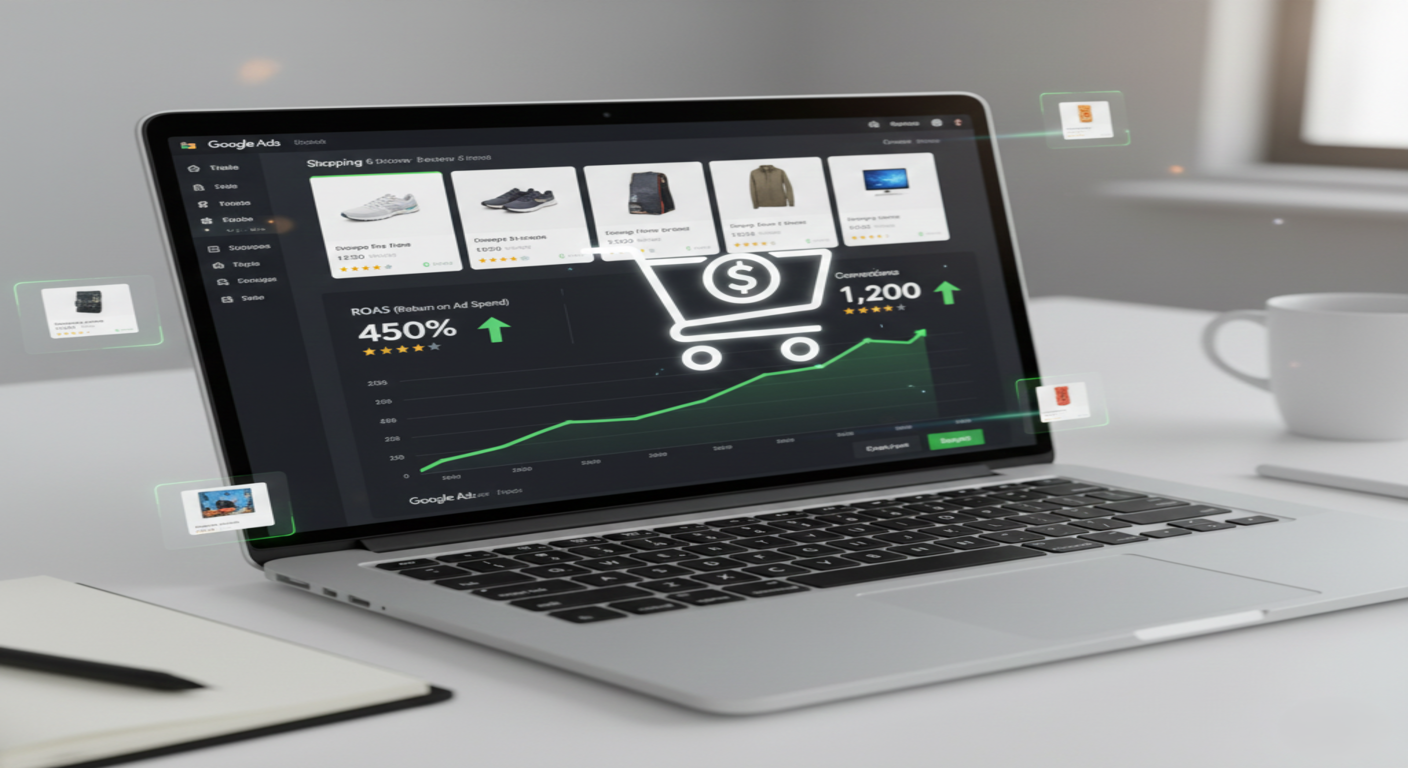
    Shopping ads show product images, prices, brand names, and reviews directly in search results. This visual format attracts high quality clicks and improves conversion rates.

    Requirements for Shopping Ads

    • Google Merchant Center account
    • Accurate product feed
    • Optimized product titles and descriptions

    Search Ads for E-commerce

    Google Search Ads target users actively searching for specific products or categories.

    Best Use Cases for Search Ads

    • Brand keywords
    • High intent product keywords
    • Promotional and discount campaigns

    Using exact match and phrase match keywords helps control costs and improve conversions.

    Performance Max Campaigns

    Performance Max for e-commerce uses automation across Search, Display, YouTube, Gmail, and Discover.

    Benefits of Performance Max

    • Uses machine learning to optimize conversions
    • Works well with Shopping feeds
    • Expands reach across multiple Google properties

    Performance Max is ideal for stores with sufficient conversion data.

    Display and Remarketing Ads

    Google Display Ads are effective for brand awareness and remarketing.

    Remarketing for E-commerce Stores

    Remarketing targets users who visited your store but did not purchase.

    • Cart abandonment campaigns
    • Product view remarketing
    • Dynamic display ads

    These campaigns significantly improve conversion rates and customer lifetime value.

    Keyword Research for Google Ads E-commerce Campaigns

    Keyword selection directly affects profitability.

    Focus on High Intent Keywords

    Use keywords like:

    • Buy running shoes online
    • Best wireless headphones price
    • Discount skincare products

    High intent keywords lead to higher click through rate and return on ad spend.

    Use Negative Keywords

    Negative keywords prevent wasted ad spend by blocking irrelevant searches. This improves Quality Score and lowers cost per click.

    Writing High Converting Ad Copy for E-commerce

    Ad copy plays a major role in attracting clicks.

    Include Keywords in Headlines

    Using primary keywords in headlines improves relevance and ad visibility.

    Highlight Offers and USPs

    Mention:

    • Free shipping
    • Easy returns
    • Limited time discounts
    • Cash on delivery

    These elements increase ad engagement and CTR.

    Landing Page Optimization for E-commerce Ads

    Even the best ads fail without optimized landing pages.

    Product Page Best Practices

    • Clear product images
    • Fast loading speed
    • Mobile friendly design
    • Strong call to action
    • Customer reviews and trust badges

    A strong landing page improves conversion rate and Google Ads Quality Score.

    Bidding Strategies for E-commerce Google Ads

    Choosing the right bidding strategy helps control profitability.

    Smart Bidding Options

    • Maximize Conversions
    • Target ROAS
    • Enhanced CPC

    For mature accounts, Target ROAS bidding works best for scaling e-commerce sales.

    Tracking and Measuring Performance

    Data driven decisions are essential for growth.

    Important Metrics to Track

    • Cost per conversion
    • Return on ad spend
    • Conversion rate
    • Average order value

    Proper conversion tracking using Google Analytics and Google Ads tags is critical.

    Common Mistakes in Google Ads for E-commerce Stores

    Avoiding these mistakes saves money and improves performance.

    Sending Traffic to Generic Pages

    Always send traffic to relevant product or category pages, not the homepage.

    Ignoring Mobile Optimization

    Most e-commerce traffic comes from mobile devices. Poor mobile experience reduces conversions.

    Not Testing Ads and Creatives

    Continuous testing of headlines, images, and offers improves long term results.

    Scaling Google Ads for E-commerce Growth

    Once campaigns are profitable, scaling becomes easier.

    Increase Budget Gradually

    Gradual scaling helps maintain performance stability.

    Expand Product Coverage

    Add more products and categories to Shopping and Performance Max campaigns.

    Optimize Based on Data

    Pause low performing products and allocate budget to high ROAS items.

    Final Thoughts on Google Ads for E-commerce Stores

    Google Ads for e-commerce stores is a powerful growth channel when executed correctly. By combining Shopping Ads, Search Ads, smart bidding, strong keyword research, and optimized landing pages, online stores can achieve consistent sales and scalable growth. Continuous testing, tracking, and optimization are the keys to maximizing profitability and staying competitive in the e-commerce landscape.
  • B2C vs B2B vs D2C E-commerce

    B2C vs B2B vs D2C E-commerce

    E-commerce has transformed how businesses sell products and services online. Among the most common models are B2C e-commerce, B2B e-commerce, and D2C e-commerce. While all three involve online transactions, they differ significantly in audience, strategy, marketing approach, and customer journey. Understanding these differences helps businesses choose the right model and build scalable digital strategies.

    What Is B2C E-commerce

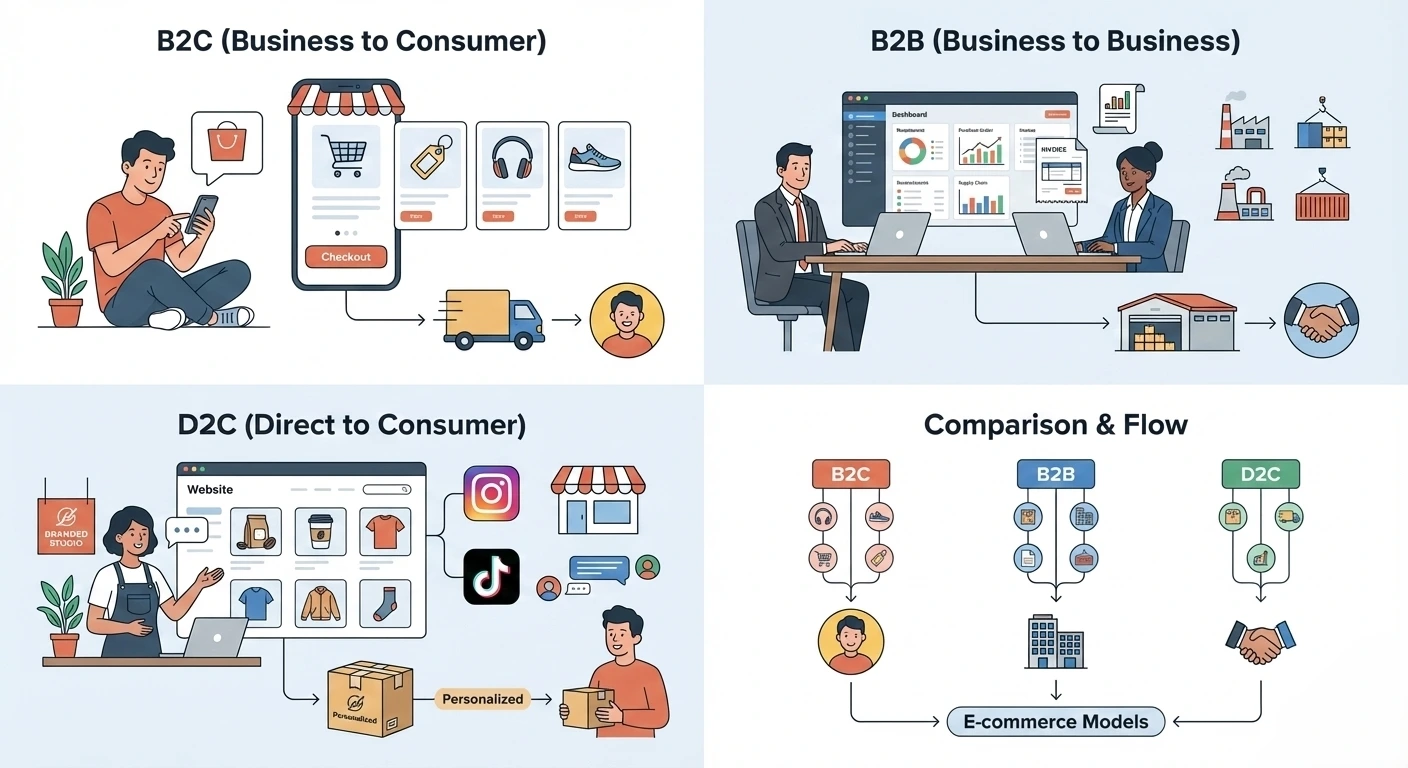
    B2C e-commerce stands for Business to Consumer. In this model, companies sell products or services directly to individual consumers through online platforms.

    Key Characteristics of B2C E-commerce

    B2C transactions are usually quick and emotionally driven. Customers expect convenience, competitive pricing, and a seamless user experience.

    Typical B2C Products

    Common B2C products include fashion, electronics, beauty items, food delivery, subscriptions, and digital services.

    B2C Buying Behavior

    Consumers often make impulse purchases. Decisions are influenced by brand perception, reviews, promotions, and ease of checkout.

    What Is B2B E-commerce

    B2B e-commerce refers to Business to Business transactions, where companies sell products or services to other businesses online.

    Key Characteristics of B2B E-commerce

    B2B sales involve larger order values, longer sales cycles, and multiple decision makers. Pricing is often customized rather than fixed.

    Typical B2B Products and Services

    B2B platforms sell raw materials, office supplies, software solutions, industrial equipment, and wholesale goods.

    B2B Buying Behavior

    Purchasing decisions are logical and research driven. Buyers focus on value, reliability, scalability, and long term partnerships rather than impulse.

    What Is D2C E-commerce

    D2C e-commerce stands for Direct to Consumer. In this model, brands sell directly to consumers without intermediaries like wholesalers or marketplaces.

    Key Characteristics of D2C E-commerce

    D2C brands own the entire customer journey, from marketing and sales to fulfillment and support.

    Typical D2C Products

    D2C is popular in fashion, skincare, fitness, electronics, and niche lifestyle products.

    D2C Buying Behavior

    Customers are attracted by brand stories, exclusivity, personalization, and direct engagement with the brand.

    Key Differences Between B2C B2B and D2C E-commerce

    Understanding how these models differ helps clarify their strategic implications.

    Target Audience and Relationship

    B2C targets individual consumers, B2B targets organizations, and D2C targets consumers but with a deeper brand relationship. D2C brands focus heavily on community and loyalty.

    Sales Cycle and Order Value

    B2C and D2C usually have shorter sales cycles and lower average order values. B2B transactions involve higher values and longer decision making processes.

    Pricing Strategy

    B2C pricing is fixed and competitive. B2B pricing is often negotiated or volume based. D2C pricing allows higher margins by eliminating middlemen.

    Marketing Approach in B2C B2B and D2C

    Each model requires a distinct marketing strategy.

    Marketing Strategy in B2C E-commerce

    B2C marketing focuses on reach, visibility, and conversions.

    Common B2C Channels

    Paid ads, social media, influencer marketing, email campaigns, and marketplace optimization are widely used.

    Key B2C Metrics

    Click through rate, conversion rate, average order value, and customer lifetime value are critical.

    Marketing Strategy in B2B E-commerce

    B2B marketing emphasizes trust, education, and relationship building.

    Common B2B Channels

    Content marketing, SEO, LinkedIn advertising, webinars, email nurturing, and account based marketing are effective.

    Key B2B Metrics

    Lead quality, cost per lead, pipeline value, and conversion rates matter more than volume.

    Marketing Strategy in D2C E-commerce

    D2C marketing blends performance with brand building.

    Common D2C Channels

    Social media ads, content marketing, influencer partnerships, email, SMS, and community building drive growth.

    Key D2C Metrics

    Customer acquisition cost, repeat purchase rate, and brand engagement are essential.

    Technology and Platform Differences

    Technology needs vary across models.

    B2C Technology Stack

    B2C platforms focus on fast checkout, mobile optimization, and scalability.

    B2B Technology Stack

    B2B platforms require bulk ordering, custom pricing, CRM integration, and approval workflows.

    D2C Technology Stack

    D2C brands need advanced analytics, personalization tools, and customer data platforms.

    Advantages and Challenges of Each Model

    Every model offers unique benefits and challenges.

    Advantages of B2C E-commerce

    High scalability, large audiences, and faster transactions make B2C attractive.

    Challenges of B2C E-commerce

    High competition, rising ad costs, and low customer loyalty can limit margins.

    Advantages of B2B E-commerce

    Higher order values, long term contracts, and predictable revenue streams are key benefits.

    Challenges of B2B E-commerce

    Long sales cycles and complex decision making slow growth.

    Advantages of D2C E-commerce

    Higher margins, full customer ownership, and brand control drive long term value.

    Challenges of D2C E-commerce

    High customer acquisition costs and logistics management can be demanding.

    Choosing the Right E-commerce Model

    Selecting between B2C vs B2B vs D2C e-commerce depends on your product, audience, resources, and growth goals. Some businesses even combine models, such as B2B brands offering D2C storefronts.

    Final Thoughts on B2C vs B2B vs D2C E-commerce

    Each e-commerce model serves a distinct purpose. B2C prioritizes convenience and scale, B2B focuses on relationships and value, and D2C emphasizes brand control and customer connection. Understanding these differences helps businesses build the right strategy, choose the right platforms, and achieve sustainable growth in the evolving digital marketplace.

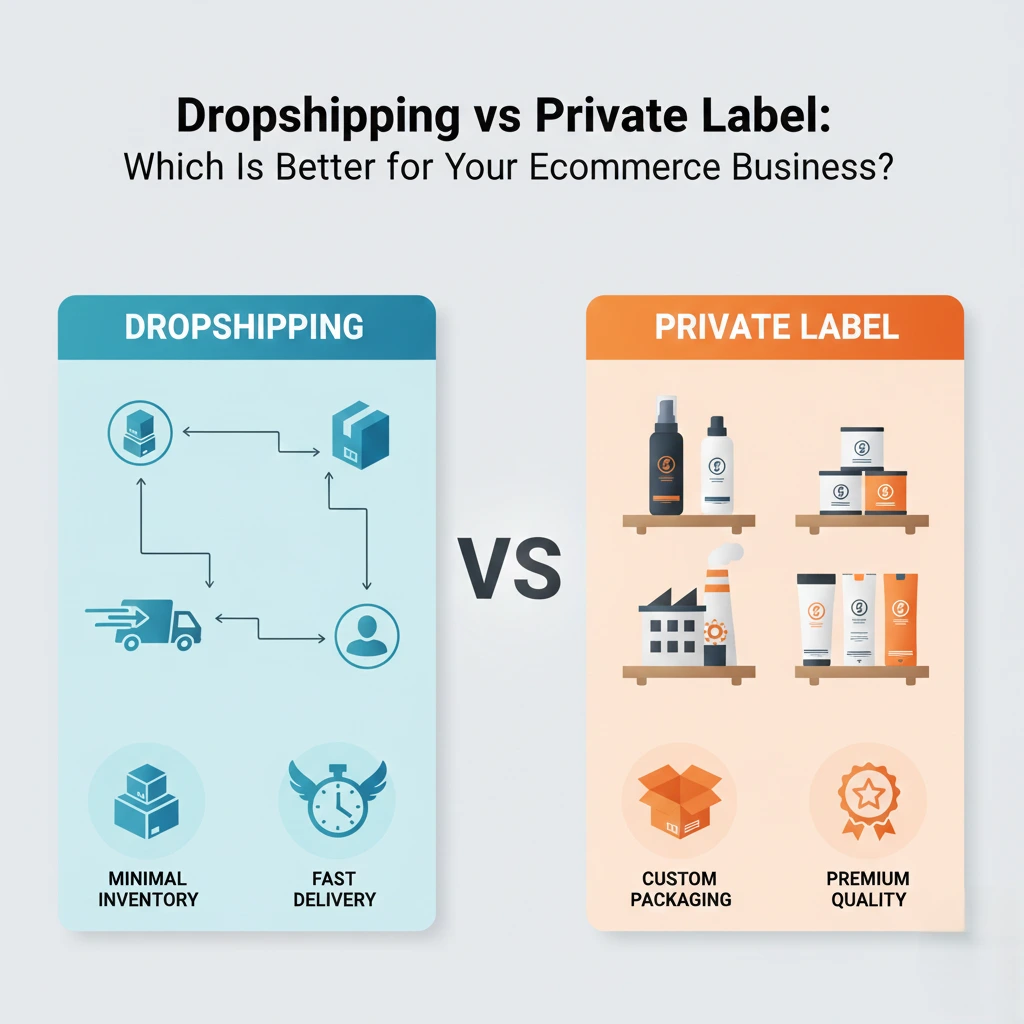
  • Dropshipping vs Private Label: Which Is Better for Your eCommerce Business?

    Dropshipping vs Private Label: Which Is Better for Your eCommerce Business?

    Choosing the right business model is one of the most important decisions when starting an eCommerce business. Two of the most popular options are dropshipping and private label. Both models allow you to sell products online, but they differ greatly in control, cost, branding, and long-term growth potential. This guide breaks down dropshipping vs private label to help you decide which is better for your goals.

    What Is Dropshipping?

    Dropshipping is an eCommerce model where you sell products without holding inventory. When a customer places an order, the product is shipped directly from a third-party supplier to the customer.

    Advantages of Dropshipping

    • Low startup cost with no inventory investment
    • Easy to launch and manage
    • Wide product selection
    • Minimal operational risk

    This model is ideal for beginners who want to test products quickly without large financial commitments.

    Disadvantages of Dropshipping

    • Low profit margins
    • Limited control over product quality and shipping
    • High competition
    • Weak brand differentiation

    Because many sellers offer the same products, standing out can be challenging.

    What Is Private Label?

    Private label means selling products manufactured by a third party but branded under your own name. You control branding, packaging, pricing, and product positioning.

    Advantages of Private Label

    • Strong brand identity
    • Higher profit margins
    • Greater control over product quality
    • Better customer loyalty and repeat purchases

    This model is best for entrepreneurs focused on building a long-term, scalable brand.

    Disadvantages of Private Label

    • Higher upfront investment
    • Inventory storage and management required
    • Longer setup time
    • Greater financial risk

    Private label businesses require more planning but offer more control.

    Dropshipping vs Private Label: Key Differences

    Startup Cost and Risk

    Dropshipping requires very little upfront capital, making it lower risk initially. Private label involves costs for manufacturing, branding, and inventory, but offers better long-term returns.

    Branding and Customization

    Private label wins in branding. You create a unique product experience, while dropshipping limits branding opportunities since products are generic.

    Profit Margins

    Private label products typically have higher margins because you control pricing. Dropshipping profits are lower due to competition and supplier pricing.

    Inventory and Fulfillment

    With dropshipping, suppliers handle inventory and shipping. With private label, you manage inventory or use third-party fulfillment services.

    Scalability

    Private label eCommerce businesses scale more effectively because they build brand equity. Dropshipping can scale quickly but is harder to sustain long term.

    Which Is Better for Beginners?

    For beginners with limited budget and experience, dropshipping is often the better starting point. It allows you to learn marketing, customer service, and product research with minimal risk.

    However, many successful entrepreneurs use dropshipping as a testing phase before transitioning to private label.

    Which Is Better for Long-Term Success?

    For long-term growth, private label is usually the better option. Strong branding, higher margins, and customer loyalty make it more sustainable in competitive markets.

    Final Verdict: Dropshipping vs Private Label

    There is no one-size-fits-all answer to dropshipping vs private label. The better choice depends on your budget, goals, and experience level.

    • Choose dropshipping if you want low risk, quick setup, and flexibility
    • Choose private label if you want brand control, higher profits, and long-term growth

    Many successful eCommerce brands start with dropshipping and evolve into private label businesses as they grow.

  • How to Start an eCommerce Business Step-by-Step: A Beginner’s Guide

    How to Start an eCommerce Business Step-by-Step: A Beginner’s Guide

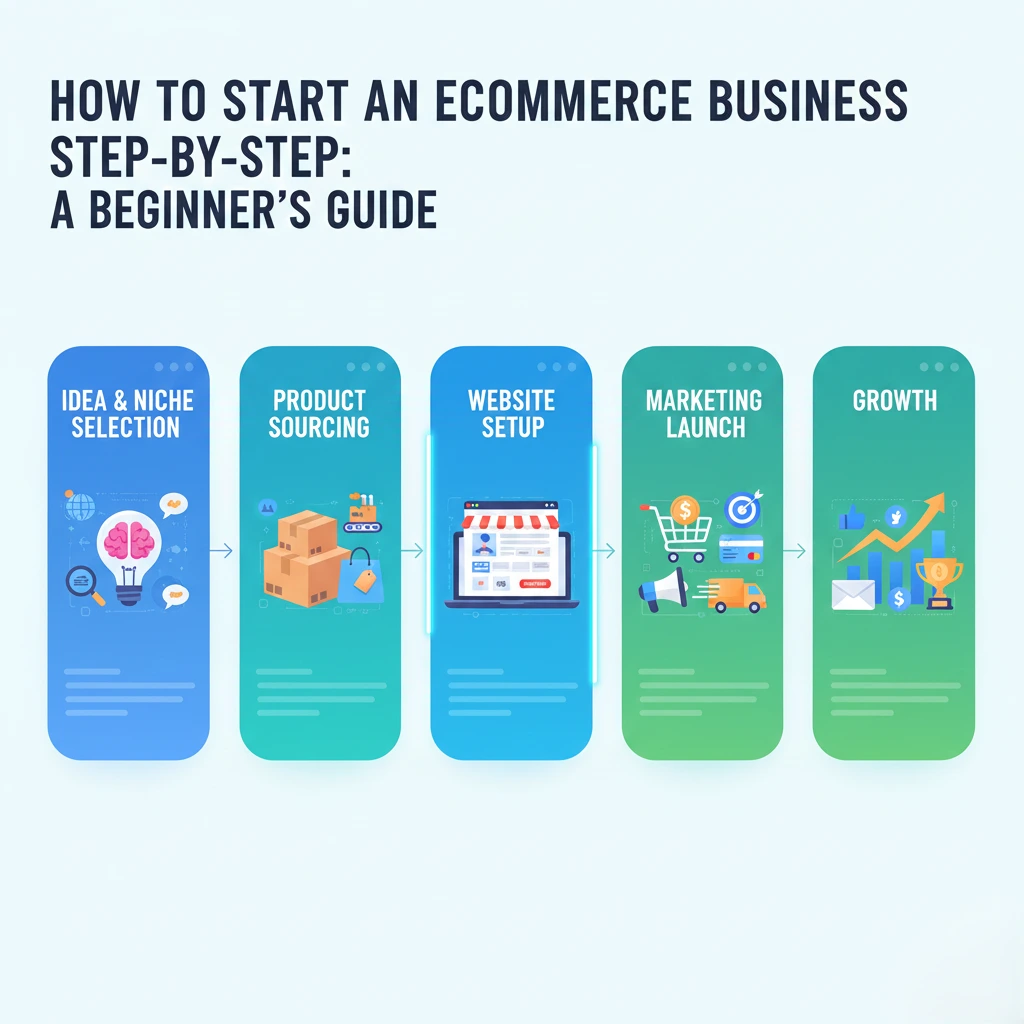
    Starting an eCommerce business is one of the most effective ways to build an online income stream. With the right planning, tools, and strategy, anyone can launch a successful online store. This step-by-step guide explains how to start an eCommerce business clearly and practically, with important keywords highlighted for easy SEO optimization.

    Step 1: Choose a Profitable eCommerce Niche

    The foundation of a successful eCommerce business is selecting the right niche. A niche defines your target audience and the type of products you sell.

    Focus on:

    • Solving a specific problem
    • Products with consistent demand
    • A clearly defined audience
    • Reasonable competition

    Popular eCommerce niches include health products, fashion accessories, home essentials, digital products, and eco-friendly goods.

    Step 2: Conduct Market Research and Validate Your Idea

    Before investing money, validate your business idea. Research competitors, analyze pricing, and study customer reviews to identify gaps in the market.

    Key validation methods:

    • Keyword research for online shopping trends
    • Competitor analysis
    • Social media demand analysis
    • Customer pain point identification

    Strong market research reduces risk and increases success chances.

    Step 3: Decide on a Business Model

    Choose the eCommerce business model that suits your goals and budget.

    Common models include:

    • Dropshipping
    • Wholesale and bulk selling
    • Print-on-demand
    • Digital products
    • Subscription-based eCommerce

    Each model has different startup costs, inventory needs, and profit margins.

    Step 4: Create a Business Plan

    A clear eCommerce business plan helps guide decisions and attract potential partners or investors.

    Your plan should include:

    • Brand mission and goals
    • Target audience profile
    • Product pricing strategy
    • Marketing and sales plan
    • Budget and revenue projections

    Planning early helps avoid costly mistakes.

    Step 5: Choose the Right eCommerce Platform

    Selecting a reliable eCommerce platform is crucial for store performance and scalability.

    Popular platforms include:

    • Shopify
    • WooCommerce
    • BigCommerce
    • Wix eCommerce

    Look for features such as mobile optimization, secure payments, SEO tools, and easy customization.

    Step 6: Register Your Business Name and Domain

    Pick a unique business name that reflects your brand. Then register a matching domain name for your online store.

    Tips for choosing a domain:

    • Keep it short and memorable
    • Avoid numbers and hyphens
    • Use relevant keywords if possible

    Brand consistency builds trust and recognition.

    Step 7: Source or Create Your Products

    Your products determine your success. Focus on quality, reliability, and customer value.

    Product sourcing options:

    • Manufacturers or suppliers
    • Handmade products
    • Private labeling
    • Digital product creation

    Always test product quality before launching your eCommerce store.

    Step 8: Build and Design Your Online Store

    A professional online store design improves conversions and customer trust.

    Key design elements:

    • Clear navigation
    • High-quality product images
    • Mobile-friendly layout
    • Fast loading speed
    • Secure checkout process

    User experience plays a major role in eCommerce success.

    Step 9: Set Up Payment Gateways and Shipping

    Enable secure payment gateways such as credit cards, digital wallets, and buy-now-pay-later options.

    Shipping setup should include:

    • Transparent shipping costs
    • Reliable delivery partners
    • Clear return and refund policies

    Trust and convenience drive higher sales.

    Step 10: Optimize for SEO and eCommerce Marketing

    SEO helps your eCommerce website rank on search engines and attract organic traffic.

    Essential optimization steps:

    • Keyword-optimized product descriptions
    • SEO-friendly URLs
    • Meta titles and descriptions
    • Fast site speed
    • Image optimization

    Combine SEO with content marketing, social media, and email marketing for better reach.

    Step 11: Launch Your eCommerce Business

    Before launch, test your website thoroughly:

    • Check all links and pages
    • Test checkout and payments
    • Review mobile responsiveness
    • Fix errors and bugs

    A smooth launch creates a strong first impression.

    Step 12: Analyze, Improve, and Scale

    After launch, track performance using analytics tools. Monitor traffic, conversion rates, and customer behavior.

    To scale your eCommerce business:

    • Expand product lines
    • Improve marketing strategies
    • Automate operations
    • Focus on customer retention

    Continuous improvement leads to long-term growth.

    Final Thoughts

    Learning how to start an eCommerce business step-by-step makes the process manageable and achievable. By choosing the right niche, building a strong brand, optimizing for SEO, and focusing on customer experience, you can create a profitable and sustainable online business.

  • Digital Product Passports & Supply Chain Transparency: Building Trust in the Modern Economy

    Digital Product Passports & Supply Chain Transparency: Building Trust in the Modern Economy

    In an era where consumers, regulators, and investors demand accountability, Digital Product Passports are emerging as a powerful tool to enable supply chain transparency. Businesses are no longer evaluated solely on price and quality; ethical sourcing, sustainability, and traceability now play a decisive role in brand trust. Digital Product Passports are transforming how companies share product information across the value chain, creating a more transparent, compliant, and sustainable global marketplace.

    What Are Digital Product Passports

    Understanding Digital Product Passports

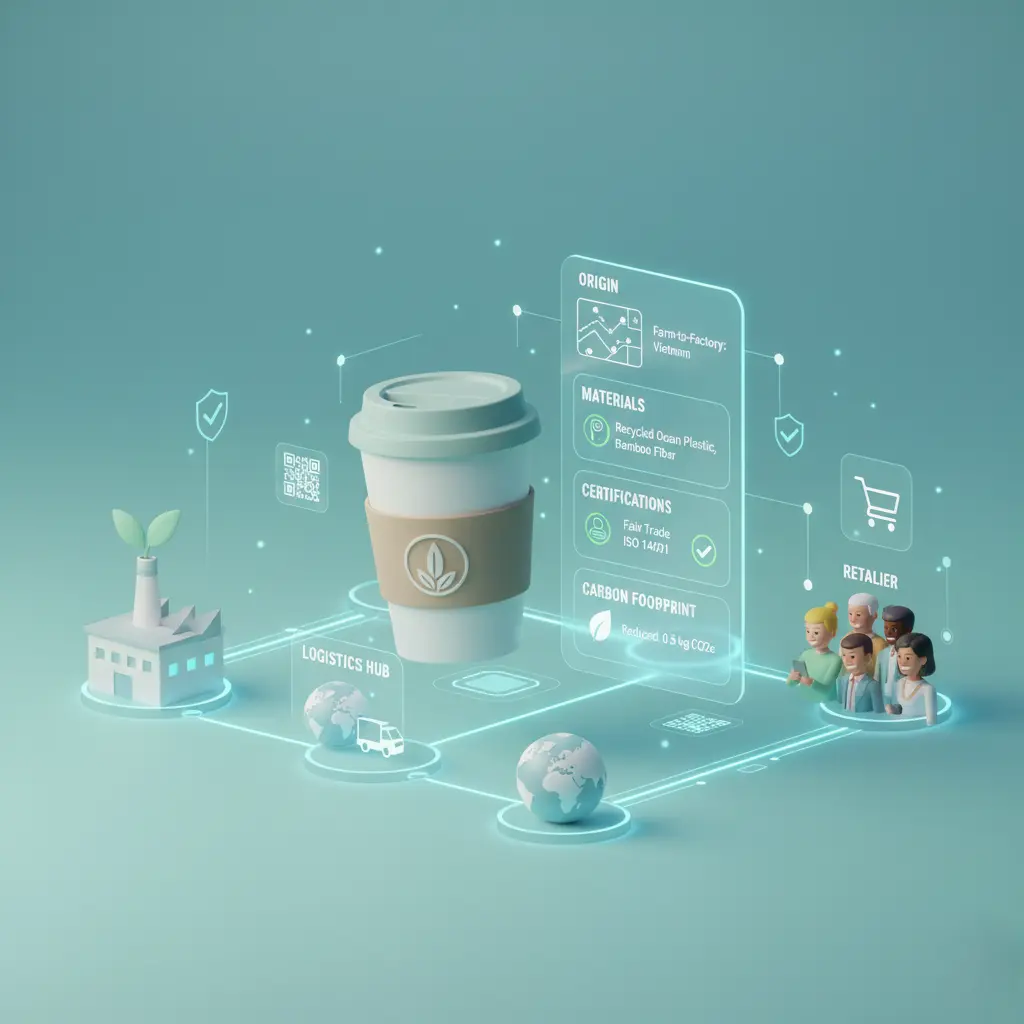
    A Digital Product Passport (DPP) is a structured digital record that contains detailed information about a product throughout its lifecycle. This includes data on raw materials, manufacturing processes, certifications, environmental impact, usage instructions, and end-of-life options. By making this information accessible to stakeholders, Digital Product Passports support informed decision-making and regulatory compliance.

    Why Digital Product Passports Matter Today

    Governments and regulatory bodies, especially in regions like the European Union, are pushing for product traceability and transparency to support sustainability goals. Digital Product Passports help businesses comply with evolving regulations while meeting growing consumer expectations for openness and responsibility. They also improve internal efficiency by creating a single source of truth for product data.

    The Role of Digital Product Passports in Supply Chain Transparency

    Enhancing End-to-End Supply Chain Visibility

    Supply chain transparency refers to the ability to track and share accurate information across every stage of the supply chain. Digital Product Passports provide end-to-end visibility, allowing companies to trace materials from origin to finished product. This reduces blind spots, improves risk management, and enables faster responses to disruptions or compliance issues.

    Building Trust with Consumers and Partners

    Transparency builds trust. When consumers can scan a QR code or access a digital record to learn where a product comes from and how it was made, confidence increases. Digital Product Passports empower brands to demonstrate authenticity, ethical sourcing, and sustainability claims with verifiable data, strengthening relationships with customers, suppliers, and regulators.

    Sustainability and Circular Economy Benefits

    Supporting Sustainable Product Design

    Digital Product Passports play a critical role in advancing sustainability. By documenting materials, energy usage, and emissions, they help companies identify areas for improvement in product design and manufacturing. This data-driven approach enables smarter decisions that reduce environmental impact and support long-term sustainability goals.

    Enabling Circular Economy Practices

    A key advantage of Digital Product Passports is their support for the circular economy. Detailed product information makes it easier to repair, reuse, refurbish, and recycle products at the end of their lifecycle. This reduces waste, extends product lifespan, and helps businesses transition from linear to circular business models.

    Compliance and Regulatory Advantages

    Meeting Evolving Regulatory Requirements

    Regulatory pressure for transparency is increasing across industries such as fashion, electronics, automotive, and manufacturing. Digital Product Passports simplify regulatory compliance by providing standardized, auditable product data. This reduces reporting complexity and minimizes the risk of penalties or reputational damage.

    Improving Risk Management and Accountability

    With greater visibility into suppliers and processes, companies can better identify risks related to labor practices, environmental impact, or material sourcing. Digital Product Passports enhance accountability across the supply chain, ensuring that standards are met consistently and issues are addressed proactively.

    Technology Powering Digital Product Passports

    Key Technologies Behind Digital Product Passports

    Several technologies enable effective Digital Product Passports, including blockchain, cloud platforms, IoT sensors, and data standards. Blockchain, in particular, ensures data integrity and tamper resistance, while IoT devices provide real-time tracking of products and materials throughout the supply chain.

    Integrating Digital Product Passports with Existing Systems

    For maximum impact, Digital Product Passports should integrate seamlessly with ERP, supply chain management, and sustainability reporting systems. Interoperability ensures that data flows smoothly across platforms, reducing duplication and improving data accuracy across the organization.

    Challenges in Implementing Digital Product Passports

    Data Accuracy and Standardization

    One of the main challenges in adopting Digital Product Passports is ensuring accurate and standardized data across diverse suppliers. Inconsistent data formats and varying levels of digital maturity can slow implementation. Establishing common standards and clear data governance frameworks is essential for success.

    Cost and Change Management Considerations

    Implementing Digital Product Passports requires investment in technology, training, and process redesign. Organizations must manage change carefully, aligning stakeholders and demonstrating the long-term value of improved supply chain transparency to secure buy-in across the business.

    The Future of Digital Product Passports and Supply Chain Transparency

    Driving Competitive Advantage Through Transparency

    As transparency becomes a baseline expectation, companies that adopt Digital Product Passports early will gain a competitive edge. Clear, accessible product information enhances brand reputation, supports sustainability claims, and differentiates businesses in crowded markets.

    Final Thoughts on Digital Product Passports

    Digital Product Passports and supply chain transparency are redefining how products are created, managed, and trusted. By embracing this approach, businesses can improve compliance, support sustainability, and build stronger relationships with consumers and partners. In a world where transparency is power, Digital Product Passports are not just a compliance tool but a strategic asset for long-term success.