Category: E-Commerce

  • Choose the Best Digital Products to Sell in Your E-Commerce Store?

    Choose the Best Digital Products to Sell in Your E-Commerce Store?

    Starting an online business has become easier than ever, and selling digital products is one of the most profitable ways to generate income online. Unlike physical goods, digital items do not require inventory, shipping, or storage. Once created, they can be sold repeatedly with minimal ongoing costs. However, choosing the right products for your store is essential to attract customers and generate consistent sales.

    If you want to build a successful e-commerce store, understanding how to select the right products based on demand, value, and audience needs is crucial.

    Understand Your Target Audience

    The first step in choosing profitable digital products is identifying your target audience. Think about who your customers are, what problems they face, and what type of solutions they are searching for online.

    For example, entrepreneurs may look for business templates, while students might prefer study guides or educational resources. By analyzing your audience’s needs, you can create valuable products that solve real problems.

    Researching customer behavior also helps you identify trending products for ecommerce store owners that are currently in demand. This allows you to create items that people are already searching for, increasing the chances of making sales.

    Research Market Demand

    Before creating or selling anything, it is important to confirm that there is demand for it. Market research helps you understand what people are buying and which niches are growing quickly.

    You can explore marketplaces, social media trends, and competitor stores to identify popular digital products in your niche. Tools like keyword research platforms and trend analysis tools can also help you discover opportunities.

    When you focus on demand-driven products, your store is more likely to attract organic traffic and loyal customers.

    Choose a Profitable Niche

    Not all markets are equally profitable. Choosing a niche helps you stand out and build authority in a specific category. Instead of selling a wide variety of unrelated items, focus on a niche where you can provide consistent value.

    Popular niches include online education, design resources, productivity tools, marketing templates, and creative assets. Many entrepreneurs succeed by selling the best digital products to sell online within a focused niche.

    When your store specializes in a particular topic, customers are more likely to trust your brand and return for future purchases.

    Focus on High-Value Products

    Customers are more willing to pay for products that offer real value. Think about creating items that save time, improve productivity, or provide useful knowledge.

    Examples include online courses, design templates, ebooks, planners, software tools, and marketing resources. High-value digital products often solve specific problems and deliver immediate benefits to users.

    Providing clear instructions, high-quality design, and useful features can make your product stand out in a competitive marketplace.

    Evaluate Scalability and Automation

    One of the biggest advantages of digital products is scalability. Once created, they can be sold an unlimited number of times without additional production costs.

    Choose products that can be delivered automatically after purchase, such as downloadable files, membership access, or automated email courses. This allows you to grow your business without increasing operational workload.

    Automation tools also help manage payments, delivery, and customer access, making your e-commerce store more efficient.

    Analyze Competitors

    Studying competitors can reveal valuable insights about pricing, packaging, and product positioning. Look at successful online stores and see what types of digital products they are offering.

    Pay attention to product descriptions, customer reviews, and marketing strategies. This research can help you identify gaps in the market where you can offer something unique.

    Learning from competitors does not mean copying them—it means understanding what works and improving upon it.

    Test and Improve Your Products

    Even with thorough research, it is important to test your products in the market. Launch a few products first and analyze customer feedback, sales performance, and engagement.

    Over time, you can refine your offerings and expand your store with additional digital products that match customer demand.

    Successful e-commerce businesses constantly adapt their strategies based on market trends and customer needs.

    Final Thoughts

    Choosing the right products is the foundation of a successful online store. By understanding your audience, researching market demand, selecting a profitable niche, and offering valuable solutions, you can build a sustainable digital business.

    The right digital products can generate passive income while helping customers achieve their goals. With careful planning and consistent improvement, your e-commerce store can grow into a reliable source of long-term revenue.


    FAQs

    1. What are digital products in e-commerce?
    Digital products are downloadable or online items such as ebooks, templates, courses, software, and design files that customers can access digitally.

    2. Are digital products profitable to sell online?
    Yes, they can be very profitable because they require no physical inventory and can be sold repeatedly without additional production costs.

    3. What are some examples of popular digital products?
    Popular options include ebooks, printable planners, online courses, design templates, stock photos, and digital marketing resources.

  • How to Reduce Shipping Costs in Ecommerce

    How to Reduce Shipping Costs in Ecommerce

    Shipping costs are one of the most significant expenses for online businesses. For small and medium-sized ecommerce stores, high shipping fees can reduce profit margins and impact customer satisfaction. Learning how to reduce shipping costs is crucial for any entrepreneur looking to maximise revenue while keeping customers happy. By implementing effective strategies, businesses can maintain competitive pricing, improve delivery times, and create a more efficient shipping process.

    This guide covers practical methods and insights to help you manage shipping expenses without compromising service quality.

    Understand Your Current Shipping Expenses

    The first step to reduce shipping costs is to analyze your current shipping processes and expenses. Break down costs by carriers, package sizes, weights, and destinations. Identify areas where expenses are unnecessarily high.

    For many ecommerce businesses, overpaying occurs due to inefficient packaging, inconsistent shipping methods, or failure to leverage discounts offered by carriers. Understanding your baseline costs allows you to implement more targeted solutions and optimize shipping workflows.

    Negotiate with Shipping Carriers

    One of the most effective ways to reduce shipping costs is to negotiate directly with carriers. Major shipping companies often offer discounted rates for businesses that ship in higher volumes.

    Even small businesses can access better rates by consolidating shipments or partnering with regional carriers. Many ecommerce platforms integrate with multiple carriers, allowing merchants to compare costs and select the most affordable shipping solution for each order.

    Optimize Packaging to Save Costs

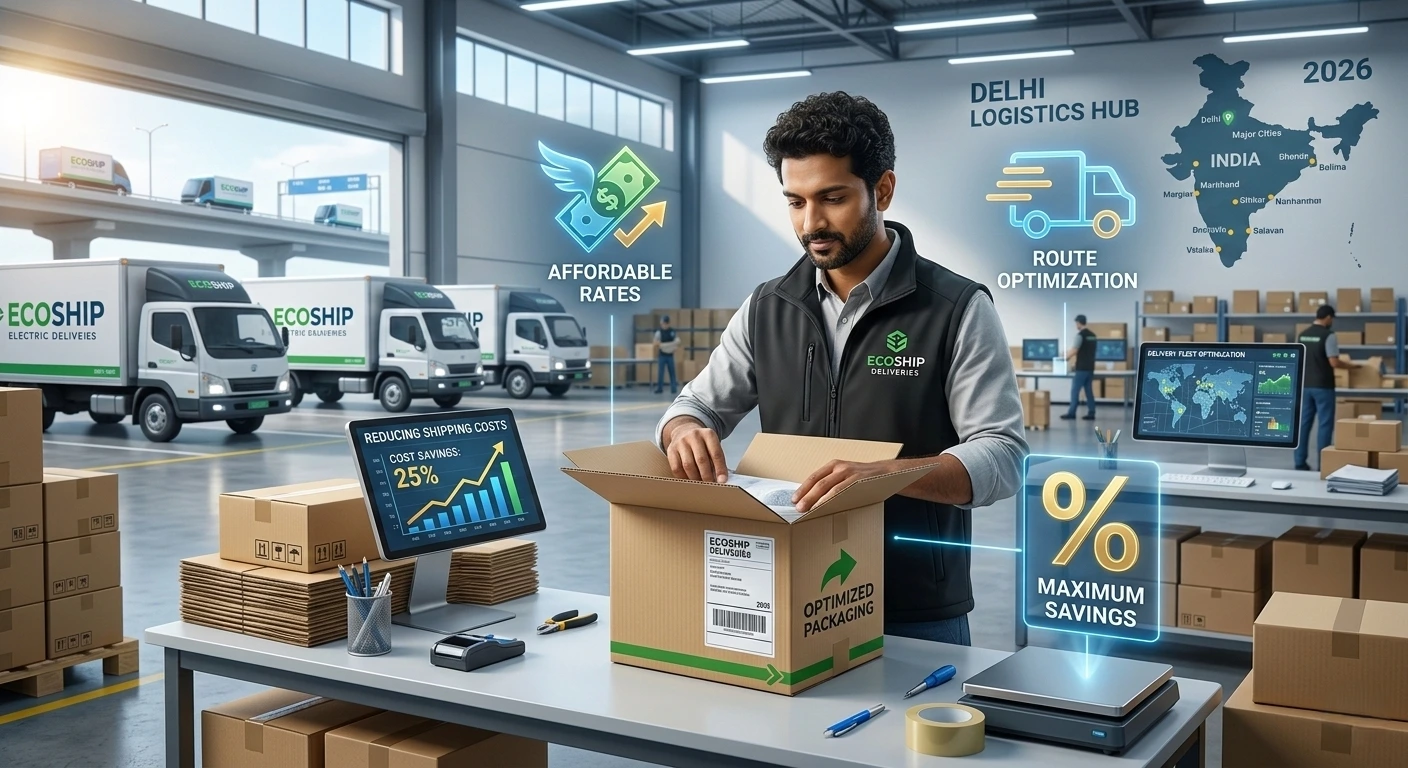
    Packaging plays a critical role in shipping expenses. Oversized boxes or excessive materials can increase both weight and dimensional weight charges. Optimizing your packaging is a practical way to reduce shipping costs.

    Using the right-sized boxes, lightweight protective materials, and standardized packaging can significantly cut costs. In addition, branded packaging should balance marketing appeal with efficiency to avoid unnecessary spending.

    Implement Ecommerce Shipping Strategies

    Adopting smart ecommerce shipping strategies can have a direct impact on profitability. For example, offering flat-rate shipping, free shipping thresholds, or regional shipping options can streamline operations and improve customer experience.

    Many online businesses use fulfillment centers strategically located near major customer bases to minimize distance and transit costs. Multi-location warehousing reduces shipping times and allows for lower rates when orders don’t need to travel across the country.

    Leverage Technology and Automation

    Technology can help ecommerce businesses reduce shipping costs by improving efficiency and reducing errors. Shipping software can automatically select the most cost-effective carrier, print labels, and calculate accurate shipping fees.

    Automated systems also allow merchants to track packages, consolidate shipments, and avoid overpaying for services they don’t need. Leveraging technology simplifies operations while keeping shipping expenses under control.

    Consider Bulk Shipping and Subscription Services

    Another practical way to reduce shipping costs is to use bulk shipping or subscription services. Purchasing shipping labels in bulk often provides substantial discounts compared to paying per shipment.

    Subscription-based solutions offered by carriers can also reduce per-package costs and include added perks like free pickups or priority processing. These affordable shipping solutions help ecommerce businesses maintain consistent shipping performance without overspending.

    Monitor and Adjust Regularly

    Shipping costs are not static, and strategies that work today may need adjustment tomorrow. Regularly monitor your shipping expenses, carrier performance, and customer satisfaction. Track which ecommerce shipping strategies yield the best results and continue refining your approach.

    By staying proactive, you can continuously find new ways to reduce shipping costs, improve delivery efficiency, and maintain a competitive edge in the online marketplace.

    Conclusion

    Reducing shipping costs is essential for sustaining profitability in ecommerce. By analyzing current expenses, negotiating with carriers, optimizing packaging, leveraging technology, and implementing smart ecommerce shipping strategies, online businesses can save money while providing excellent customer service.

    Focusing on efficiency and adopting affordable shipping solutions ensures that your ecommerce business remains competitive and profitable in a highly competitive market. Small changes can lead to significant savings over time, benefiting both your business and your customers.

    FAQs

    How can small businesses reduce shipping costs?

    Small businesses can reduce shipping costs by negotiating rates with carriers, optimizing packaging, using regional fulfillment centers, and leveraging shipping software.

    What is the most affordable shipping solution for ecommerce?

    Affordable shipping solutions include using bulk shipping discounts, regional carriers, subscription-based shipping services, and automated shipping platforms to find the lowest rates.

    Does packaging impact shipping costs?

    Yes, using oversized or heavy packaging can increase shipping fees. Optimizing packaging size and weight is an effective way to reduce shipping costs.

  • How to Start an Ecommerce Business in 2026

    How to Start an Ecommerce Business in 2026

    Starting an online store has become one of the most popular ways to build a profitable venture in today’s digital economy. With global online shopping continuing to grow, many entrepreneurs are exploring how to launch a successful ecommerce business. In 2026, modern technology, automation tools, and digital marketing strategies have made it easier than ever to enter the online marketplace. However, success still requires careful planning, the right platform, and a strong understanding of your target audience.

    This ecommerce business guide will help you understand the key steps needed to launch and grow a successful online store.

    Choose a Profitable Niche

    The first step in building a successful ecommerce business is selecting the right niche. A niche defines the type of products you sell and the audience you serve. Instead of selling a wide range of unrelated products, it is often better to focus on a specific category.

    For example, you might sell eco-friendly home products, pet supplies, or fitness equipment. Choosing a niche with consistent demand and limited competition can make it easier to stand out in the market. Researching customer needs, trending products, and market gaps is an important part of this process.

    Following proven ecommerce startup tips, entrepreneurs should focus on niches where they have interest or knowledge, as this helps create better marketing and branding strategies.

    Select the Right Ecommerce Platform

    The next important step is choosing the platform where your online store will operate. Many platforms allow beginners to launch an online store without advanced technical skills.

    Popular options include hosted solutions that provide templates, payment integrations, and inventory management tools. These platforms simplify the process of launching an ecommerce business, allowing entrepreneurs to focus more on product sourcing and marketing.

    When choosing a platform, consider factors such as customization options, payment gateways, mobile optimization, and scalability. A flexible platform ensures your store can grow as your business expands.

    Source High-Quality Products

    Product quality plays a crucial role in customer satisfaction and long-term growth. Whether you manufacture your own products, purchase from wholesalers, or use dropshipping, reliable suppliers are essential.

    Many successful entrepreneurs build their ecommerce business by partnering with suppliers who provide consistent product quality and timely delivery. Research supplier reviews, request samples, and test products before selling them.

    Another strategy mentioned in many ecommerce startup tips is private labeling, where businesses sell products under their own brand name. This approach helps create a unique brand identity and improves customer loyalty.

    Build a Professional Online Store

    Your website is the digital storefront of your brand. A well-designed site builds trust and encourages visitors to make purchases. Important elements include clear product descriptions, high-quality images, secure payment options, and easy navigation.

    A strong ecommerce business guide always emphasizes the importance of user experience. If customers find it difficult to browse products or complete purchases, they may leave your store and shop elsewhere.

    Mobile optimization is also essential. A large percentage of online shoppers now use smartphones, so ensuring that your store functions smoothly on mobile devices can significantly improve conversions.

    Develop a Marketing Strategy

    Marketing is the driving force behind every successful ecommerce business. Without effective promotion, even great products may go unnoticed.

    Digital marketing channels such as search engine optimization (SEO), social media marketing, email campaigns, and paid advertisements can help attract potential customers. Creating valuable content and engaging with audiences on social platforms also increases brand visibility.

    One of the most effective ecommerce startup tips is building an email list. Email marketing allows businesses to promote new products, offer discounts, and maintain long-term relationships with customers.

    Focus on Customer Experience

    Customer satisfaction plays a major role in the growth of any online store. Fast shipping, responsive customer support, and clear return policies help build trust and encourage repeat purchases.

    A successful ecommerce business also pays attention to customer feedback. Reviews and ratings provide valuable insights that help improve products and services.

    Providing personalized shopping experiences, such as product recommendations and loyalty rewards, can further enhance customer relationships and increase long-term sales.

    Scale Your Ecommerce Business

    Once your store begins generating consistent sales, the next step is scaling. Expansion strategies may include introducing new products, entering international markets, or investing in advanced marketing campaigns.

    Automation tools can help manage tasks such as inventory tracking, customer service, and order fulfillment. These tools allow entrepreneurs to focus on growth strategies rather than daily operational challenges.

    Scaling an ecommerce business requires careful planning and continuous monitoring of performance metrics such as traffic, conversion rates, and customer retention.

    Conclusion

    Starting an online store in 2026 presents exciting opportunities for aspiring entrepreneurs. With the right niche, reliable suppliers, effective marketing strategies, and a customer-focused approach, anyone can build a successful ecommerce business.

    By following a structured ecommerce business guide and applying proven ecommerce startup tips, beginners can avoid common mistakes and build a strong foundation for long-term success in the digital marketplace.

    FAQs

    How much money is needed to start an ecommerce business?

    The startup cost can vary widely depending on the platform, product sourcing method, and marketing budget. Some online stores can start with a few hundred dollars, while others require larger investments.

    What is the best platform for beginners?

    Many beginners prefer user-friendly platforms that offer ready-made templates, payment integrations, and simple store management tools.

    How long does it take to make profit from an ecommerce store?

    Profit timelines vary depending on marketing strategy, product demand, and competition. Some stores see results within a few months, while others take longer to grow.

  • What is Logistics Management? A Beginner’s Guide

    What is Logistics Management? A Beginner’s Guide

    Introduction

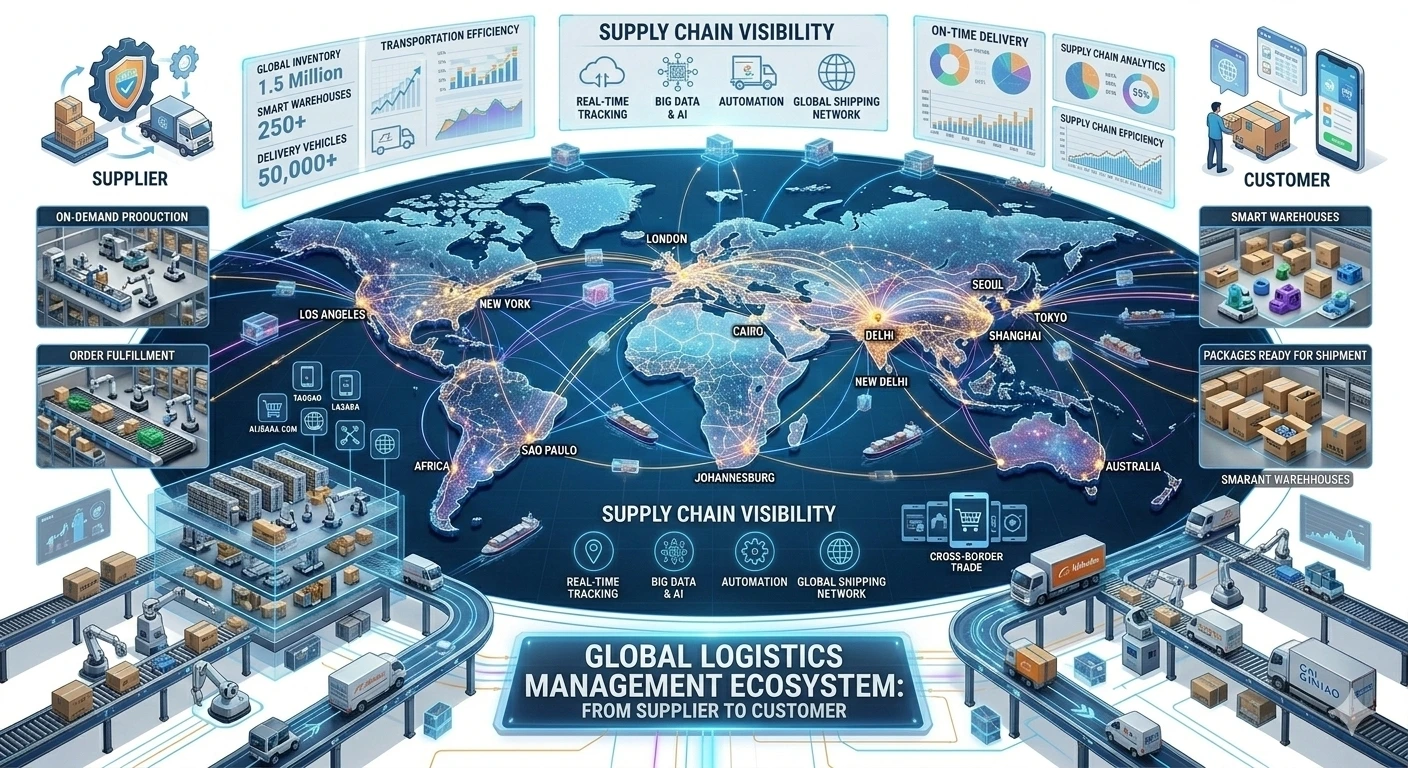
    In today’s fast-paced global economy, businesses rely heavily on efficient transportation, storage, and delivery of goods. This entire process is controlled through Logistics Management, which plays a critical role in ensuring that products move smoothly from suppliers to customers. Whether a company sells products online or operates a traditional retail business, effective Logistics Management helps maintain operational efficiency and customer satisfaction.

    For beginners, understanding Logistics Management is essential because it directly impacts cost control, inventory handling, and timely delivery. Without proper Logistics Management, businesses may face delays, increased expenses, and dissatisfied customers.

    Understanding Logistics Management

    At its core, Logistics Management refers to the planning, implementation, and control of the movement and storage of goods, services, and related information within a supply chain. The goal is to ensure that the right product reaches the right customer at the right time and at the lowest possible cost.

    Businesses use Logistics Management to coordinate transportation, inventory storage, warehouse operations, and order fulfillment. A well-organized system ensures that products are available when customers need them while reducing waste and operational delays.

    Many modern companies rely on advanced software tools and technologies to manage their logistics activities. These tools help track shipments, monitor inventory levels, and improve delivery accuracy. As a result, companies can improve their Logistics Management efficiency and maintain a competitive advantage in the market.

    Logistics Management Process

    The logistics management process involves several key stages that work together to move goods efficiently through the supply chain.

    First is procurement and sourcing. Businesses must obtain raw materials or products from suppliers. Proper planning ensures that the right quantity of goods is purchased at the right time.

    Second is inventory management. Companies store products in warehouses or distribution centers until they are ready to be shipped to customers. Maintaining accurate inventory levels helps prevent stock shortages and overstocking.

    The next stage is transportation management. Goods must be transported from suppliers to warehouses and finally to customers. Companies choose transportation methods such as road, rail, air, or sea depending on cost, speed, and distance.

    Order fulfillment is another critical step. This includes picking, packing, and shipping customer orders quickly and accurately. An efficient logistics management process ensures smooth coordination between these activities.

    Finally, companies track and monitor shipments to ensure timely delivery. Modern tracking systems allow businesses and customers to monitor the movement of goods in real time.

    Logistics Management Benefits

    Implementing an effective logistics system provides several important advantages for businesses. One of the most significant logistics management benefits is improved operational efficiency. When logistics activities are well organized, businesses can reduce delays and avoid unnecessary costs.

    Another major logistics management benefits is better customer satisfaction. Customers expect fast and reliable deliveries, and efficient logistics ensures that orders arrive on time and in good condition.

    Cost reduction is also a key advantage. Efficient planning and transportation management help businesses minimize fuel costs, storage expenses, and inventory losses.

    In addition, businesses gain improved visibility into their supply chain operations. With better tracking and monitoring systems, companies can quickly identify problems and make informed decisions to improve performance.

    Scalability is another benefit. As businesses grow, a strong logistics system allows them to handle increased order volumes without disrupting operations.

    The Role of Technology in Logistics

    Technology has transformed Logistics Management in recent years. Businesses now use digital platforms, automation tools, and data analytics to improve logistics operations.

    Warehouse management systems help organize storage spaces and streamline picking and packing activities. Transportation management systems help businesses plan optimal delivery routes and reduce shipping costs.

    Real-time tracking technology also allows businesses and customers to monitor shipments. This transparency improves trust and helps companies quickly respond to delays or disruptions.

    Conclusion

    For any business that deals with physical products, Logistics Management is a fundamental component of success. It ensures that goods move efficiently through the supply chain, from suppliers to customers.

    By understanding the logistics management process and recognizing the key logistics management benefits, businesses can improve efficiency, reduce costs, and deliver better customer experiences. As technology continues to evolve, effective Logistics Management will become even more important for companies looking to stay competitive in a rapidly changing marketplace.

  • Warehouse vs Fulfillment Centers: What’s the Difference?

    Warehouse vs Fulfillment Centers: What’s the Difference?

    Introduction

    Businesses that store and ship products often rely on warehouses or fulfillment centers to manage inventory and deliveries. While these two facilities may appear similar, they serve different purposes in the supply chain. Understanding the difference between them is important for companies that want to improve logistics operations and customer satisfaction.

    The concept of Warehouse vs Fulfillment Center is especially important for ecommerce businesses that need fast and accurate order deliveries. Both facilities handle storage and shipping, but the way they operate and the services they provide can vary significantly. Choosing the right option depends on business goals, order volume, and customer expectations.

    What is a Warehouse?

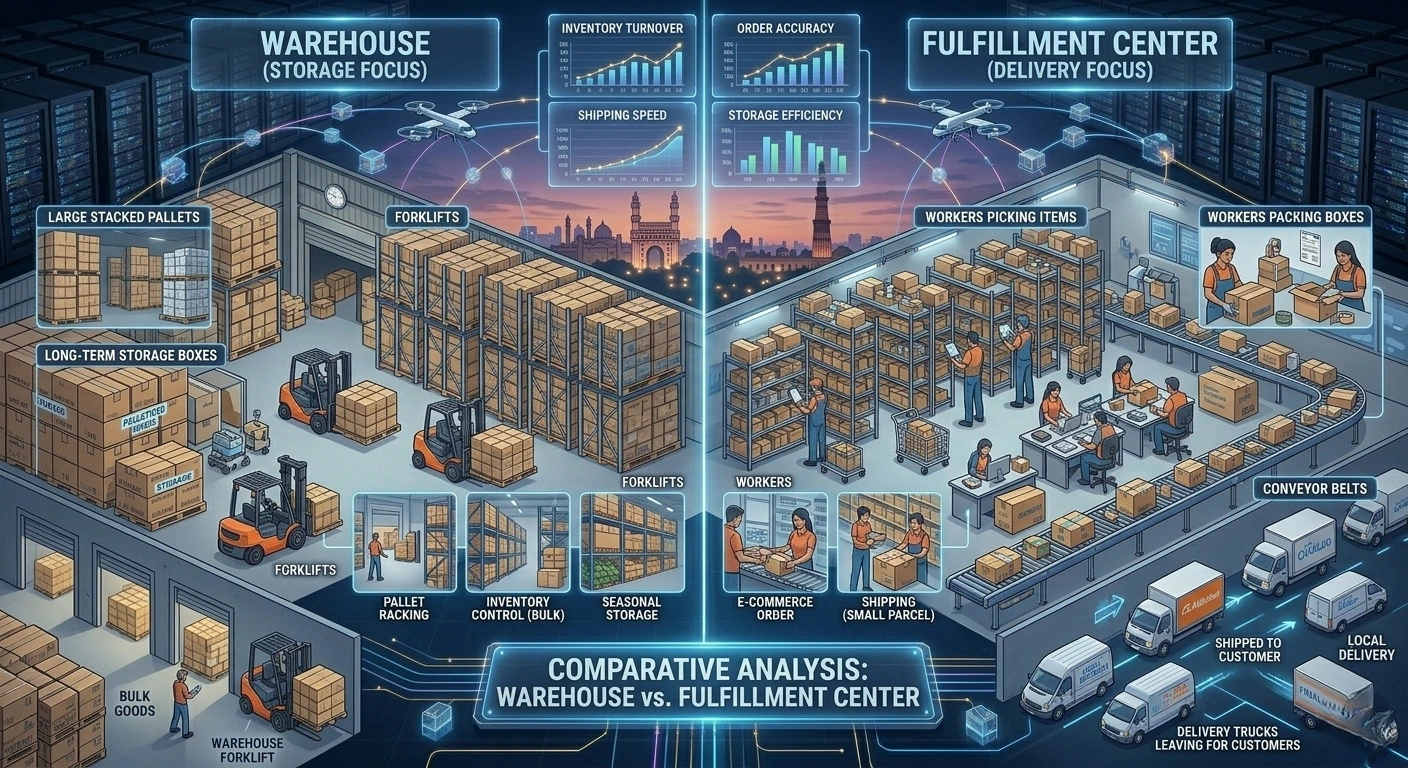
    A warehouse is a large storage facility where businesses keep goods for an extended period before they are sold or distributed. Warehouses are primarily designed for inventory storage and are commonly used by manufacturers, wholesalers, and retailers.

    In the discussion of Warehouse vs Fulfillment Center, a warehouse typically focuses on storing large quantities of products rather than processing individual customer orders. Goods may stay in a warehouse for weeks or even months until they are needed.

    Warehouse operations usually include receiving shipments, organizing inventory, and maintaining stock levels. Many businesses also use warehouse management systems to track inventory and improve efficiency. Warehouses play a vital role in the supply chain because they help businesses manage bulk inventory and maintain product availability.

    What is a Fulfillment Center?

    A fulfillment center is a specialized facility designed to handle the entire order fulfillment process for businesses, especially ecommerce stores. Instead of just storing products, fulfillment centers focus on processing and shipping customer orders quickly.

    When comparing Warehouse vs Fulfillment Center, the key difference lies in how products move through the facility. Fulfillment centers manage high volumes of daily orders and ensure that customers receive their purchases as quickly as possible.

    These facilities provide a variety of fulfillment center services, including inventory storage, order picking, packing, shipping, and returns management. Ecommerce companies often partner with third-party logistics providers that operate fulfillment centers to streamline their logistics operations.

    Because fulfillment centers are built for speed and efficiency, products usually do not remain there for long periods. Instead, they move quickly through the system as orders are processed and shipped.

    Key Differences Between Warehouse and Fulfillment Center

    Understanding the major differences between these two facilities helps businesses make better logistics decisions. The comparison of Warehouse vs Fulfillment Center often focuses on purpose, operations, and order processing.

    Warehouses are mainly used for long-term storage of goods, while fulfillment centers are designed for fast order processing and shipping. Businesses that need to store bulk inventory for extended periods usually prefer warehouses.

    Fulfillment centers, on the other hand, handle individual customer orders and focus on rapid delivery. This makes them ideal for ecommerce businesses that require efficient shipping operations.

    Another difference lies in daily operations. Warehouses generally deal with large shipments moving between suppliers, manufacturers, or retailers. Fulfillment centers handle smaller shipments that go directly to customers.

    Technology and automation are also more common in fulfillment centers because they need to process a high number of orders each day. These advanced systems support fulfillment center services such as order tracking, packing automation, and shipping optimization.

    Warehouse vs Distribution Center

    Many people also compare warehouses with distribution centers when discussing logistics facilities. The topic of warehouse vs distribution center highlights another important distinction in supply chain operations.

    A warehouse mainly focuses on storing goods, while a distribution center is designed to move products quickly through the supply chain. Distribution centers receive products from manufacturers and then distribute them to retailers or customers.

    In many cases, fulfillment centers operate similarly to distribution centers because they process orders and ship products quickly. Understanding the concept of warehouse vs distribution center helps businesses determine which facility best supports their supply chain strategy.

    Which One is Right for Your Business?

    Choosing between the two depends on your business model and logistics needs. The discussion of Warehouse vs Fulfillment Center becomes especially relevant for growing ecommerce companies.

    If your business requires long-term inventory storage and deals with bulk shipments, a warehouse may be the better option. Warehouses are ideal for businesses that supply retailers or maintain large stock levels.

    However, if your company sells products directly to customers online, fulfillment centers may be more suitable. Their ability to manage orders quickly and provide efficient fulfillment center services can significantly improve delivery speed and customer satisfaction.

    Businesses experiencing rapid growth may also benefit from fulfillment centers because they can handle large volumes of orders without requiring companies to manage their own logistics infrastructure.

    Conclusion

    Understanding the difference between Warehouse vs Fulfillment Center is essential for businesses that want to optimize their supply chain operations. While warehouses are designed primarily for storage, fulfillment centers focus on fast order processing and shipping.

    By evaluating their logistics requirements and customer expectations, businesses can determine which solution best supports their operations. Whether a company chooses a warehouse for inventory storage or a fulfillment center for order processing, selecting the right logistics facility can improve efficiency, reduce costs, and enhance the overall customer experience.