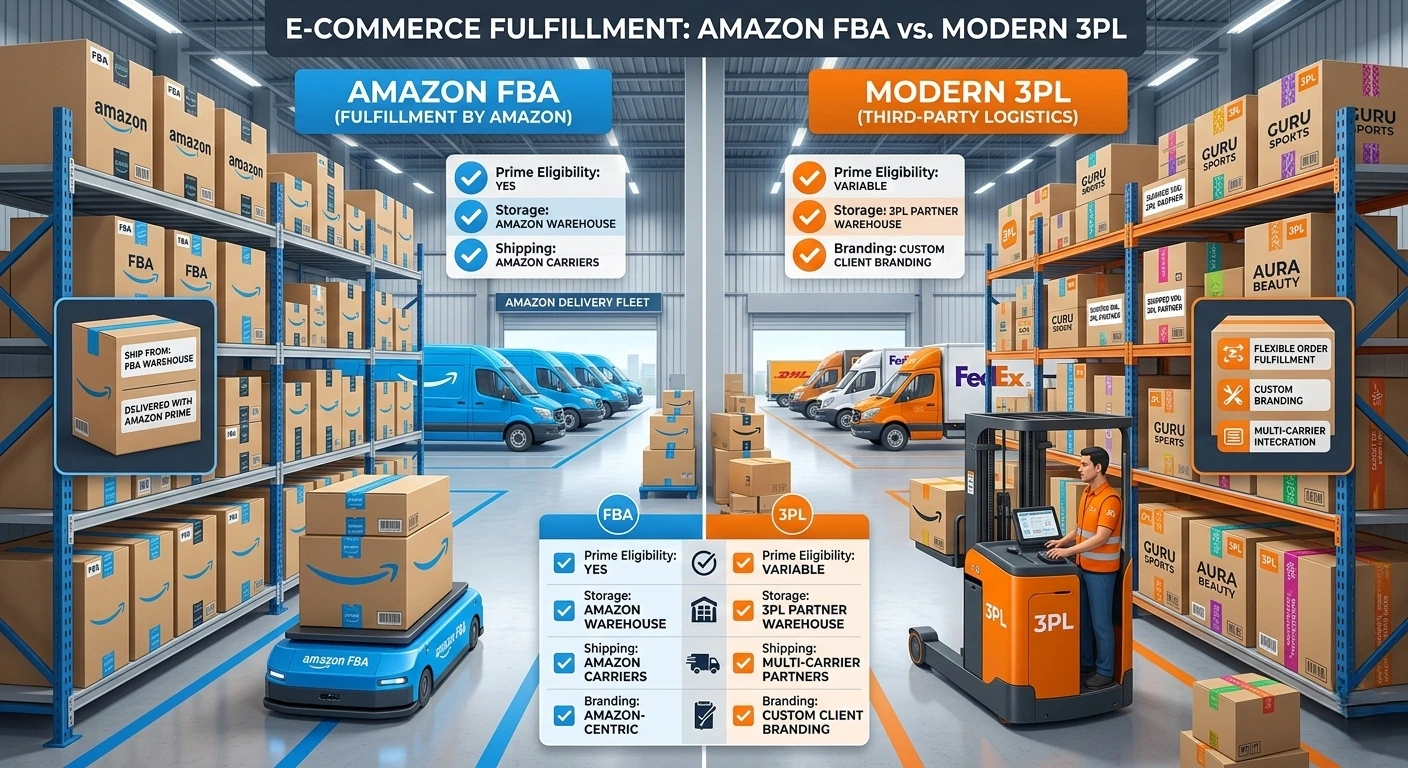
As ecommerce brands scale, fulfillment becomes either a growth engine or a bottleneck. One of the most debated topics among modern sellers is Amazon FBA vs 3PL. Both models promise streamlined logistics, faster shipping, and operational efficiency, but the right choice depends on your sales channels, margins, and long-term strategy.
In this guide, we’ll break down Amazon FBA vs 3PL in detail so you can confidently choose the best fulfillment model for your growing brand.
What Is Amazon FBA?
Amazon offers Fulfillment by Amazon (FBA), a service where sellers store products in Amazon’s warehouses, and Amazon handles picking, packing, shipping, returns, and customer service.
With FBA, your products qualify for Prime shipping, which can significantly boost conversion rates. For brands selling primarily on Amazon, this is a major advantage.
However, understanding FBA fees is critical. These include storage fees, fulfillment fees, long-term storage penalties, and seasonal surcharges. While FBA simplifies operations, margins can shrink quickly if inventory turnover slows down.
Benefits of Amazon FBA
Prime eligibility and fast shipping
Access to Amazon’s massive customer base
Hands-off logistics management
Built-in customer service and returns handling
Limitations of Amazon FBA
Limited branding control
Complex and rising FBA fees
Storage limits and restock restrictions
Multi-channel fulfillment can be costly
When comparing Amazon FBA vs 3PL, FBA works best for brands heavily dependent on Amazon’s ecosystem.
What Is a 3PL?
A Third-Party Logistics (3PL) provider is an independent company that stores inventory and fulfills orders on your behalf. Unlike FBA, a 3PL supports multiple sales channels including your website, marketplaces, and retail distribution.
Many ecommerce businesses using Shopify rely on a 3PL for Shopify integration to automate order routing and inventory syncing.
A 3PL offers broader ecommerce fulfillment solutions, including custom packaging, kitting, subscription boxes, and B2B shipping.
Benefits of Using a 3PL
Multi-channel fulfillment flexibility
Stronger branding and packaging customization
Transparent pricing models
Better control over inventory distribution
Limitations of a 3PL
No built-in marketplace traffic
You manage customer service separately
Shipping speeds depend on warehouse locations
For brands expanding beyond Amazon, Amazon FBA vs 3PL becomes less about convenience and more about control and scalability.
Cost Comparison: FBA Fees vs 3PL Pricing
Cost is often the deciding factor in the Amazon FBA vs 3PL debate.
FBA fees are standardized but can be unpredictable due to peak season surcharges and storage penalties. Long-term storage especially impacts slow-moving products.
A 3PL typically charges for storage (per pallet, bin, or cubic foot), pick and pack fees, shipping labels, and sometimes onboarding costs. While it may appear more complex, many brands find 3PL pricing more transparent over time.
If your catalog includes oversized, seasonal, or bundled products, comparing Amazon FBA vs 3PL carefully can reveal major savings opportunities.
Branding and Customer Experience
Brand control is another critical factor in Amazon FBA vs 3PL.
With FBA, orders arrive in Amazon-branded packaging. Customer data is limited, restricting your ability to build direct relationships.
With a 3PL, you control packaging, inserts, promotional materials, and unboxing experiences. This is essential for DTC brands focused on loyalty and repeat purchases.
For companies investing in premium ecommerce fulfillment solutions, a 3PL often provides the flexibility required to stand out in competitive markets.
Multi-Channel Growth and Scalability
If you plan to sell exclusively on Amazon, FBA may be sufficient. But most modern brands diversify across marketplaces, retail, and direct-to-consumer websites.
In that scenario, Amazon FBA vs 3PL becomes a scalability question.
A 3PL for Shopify stores enables seamless fulfillment across your website, Amazon, Walmart, and even wholesale accounts. You avoid splitting inventory across different systems, reducing stockouts and forecasting errors.
Many growing brands actually adopt a hybrid model, using FBA for Amazon orders and a 3PL for all other channels. When evaluating Amazon FBA vs 3PL, hybrid logistics can offer the best of both worlds.
Inventory Management and Flexibility
Inventory restrictions are increasingly common within Amazon’s warehouses. Restock limits can disrupt sales momentum during peak seasons.
A 3PL typically offers greater flexibility in inbound shipments and storage capacity. For brands launching new SKUs or running flash promotions, that flexibility can be invaluable.
When analyzing Amazon FBA vs 3PL, consider how much operational control you want over forecasting and replenishment.
Which Is Better for Growing Brands?
There is no universal winner in the Amazon FBA vs 3PL comparison. The right solution depends on your growth stage and channel strategy.
Choose FBA if:
You sell primarily on Amazon
Prime eligibility drives most of your revenue
You prefer hands-off logistics
Choose a 3PL if:
You sell across multiple channels
Branding and customer experience matter deeply
You want predictable long-term fulfillment costs
You need flexible ecommerce fulfillment solutions
For many scaling brands, the smartest move isn’t Amazon FBA vs 3PL as an either-or decision. Instead, it’s about building a fulfillment strategy that evolves with your business.
By carefully evaluating FBA fees, operational control, and multi-channel expansion plans, you can select the fulfillment infrastructure that supports sustainable, profitable growth.
Leave a Reply