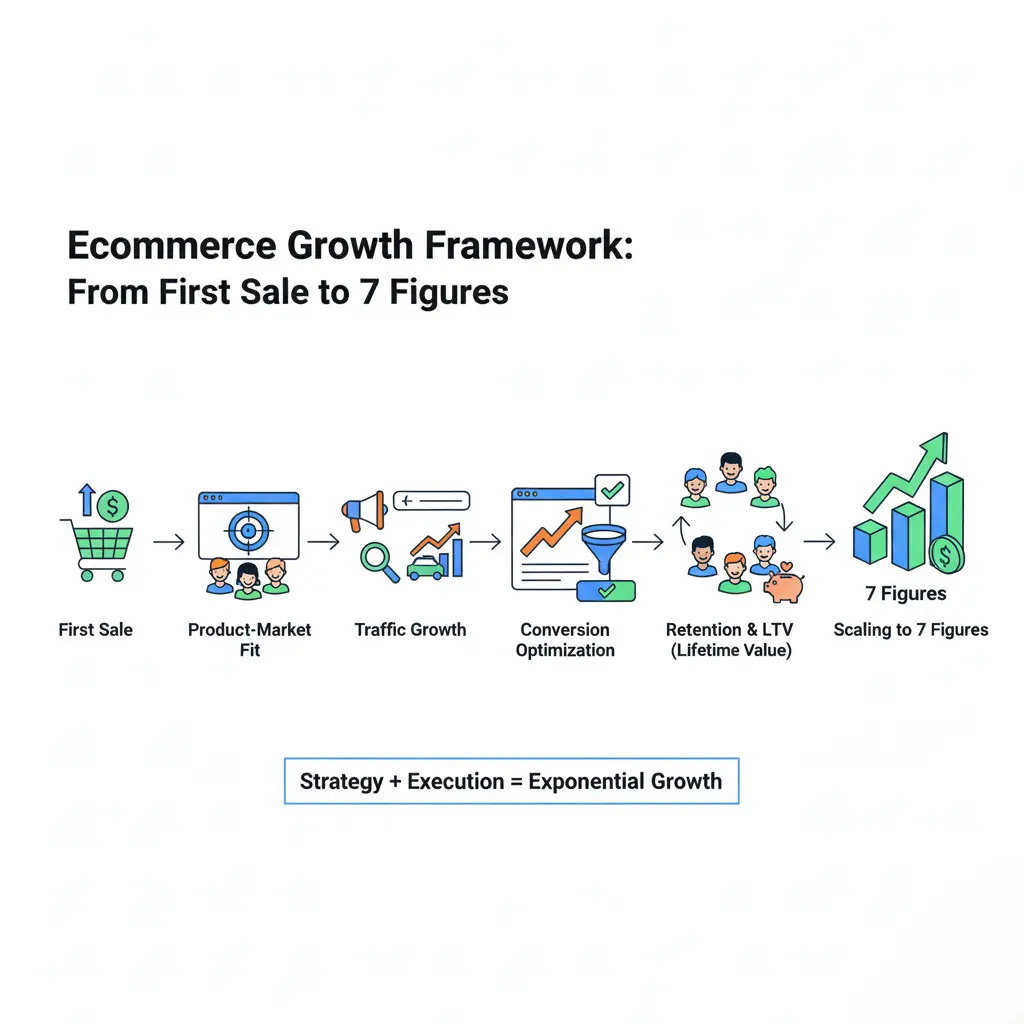
Scaling an ecommerce business is not about luck or viral products. Sustainable success comes from systems, strategy, and consistent execution. The ecommerce growth framework provides a clear roadmap that takes brands from their first sale to seven-figure revenue and beyond.
This guide breaks down the essential stages of ecommerce growth and explains what to focus on at each phase.
Stage 1: Achieving Your First Ecommerce Sale
Validating Product-Market Fit
The first milestone in ecommerce is proving that customers are willing to pay for your product. At this stage, the goal is not scale—it’s validation. Successful brands focus on identifying a real problem, a defined audience, and a compelling value proposition.
Key Focus Areas
Early-stage ecommerce growth strategies include:
- Simple product pages with clear messaging
- Strong product-market alignment
- Initial traffic from organic, social, or paid channels
- Basic analytics to track conversions
Once the first consistent sales come in, it’s time to move beyond experimentation.
Stage 2: Building a Repeatable Sales System
Optimizing the Ecommerce Funnel
After initial traction, brands must focus on conversion optimization. This includes improving product pages, checkout flow, and customer trust signals such as reviews, FAQs, and guarantees.
Traffic Channel Testing
Growing ecommerce brands test multiple traffic sources:
- Paid ads on Google, Meta, or TikTok
- SEO-driven content marketing
- Influencer and affiliate partnerships
- Email and SMS remarketing
The objective is to identify at least one reliable acquisition channel that can be scaled profitably.
Stage 3: Retention and Customer Lifetime Value
Why Retention Fuels Ecommerce Growth
Most ecommerce brands fail because they focus only on acquiring new customers. Long-term profitability comes from retention. Increasing customer lifetime value allows you to spend more on acquisition without sacrificing margins.
Retention Strategies That Work
High-performing ecommerce growth frameworks prioritize:
- Email and SMS automation
- Personalized product recommendations
- Loyalty and referral programs
- Post-purchase education and engagement
Retention transforms one-time buyers into brand advocates.
Stage 4: Scaling to Six Figures
Systems, Not Hustle
At the six-figure level, operational efficiency becomes critical. Brands that scale successfully rely on systems rather than constant manual effort.
What to Optimize at This Stage
Key priorities include:
- Inventory management and forecasting
- Outsourcing fulfillment and customer support
- Advanced analytics and attribution
- Streamlined ad creatives and offers
Scaling without systems leads to burnout and inconsistent growth.
Stage 5: Brand Building and Authority
Transitioning From Store to Brand
Seven-figure ecommerce brands think beyond transactions. They invest in brand storytelling, community building, and long-term positioning. This creates differentiation in competitive markets.
Content and Social Proof
Strong brands leverage:
- User-generated content
- Social proof and testimonials
- Educational and lifestyle content
- Consistent brand voice across channels
Brand trust reduces acquisition costs and increases conversion rates.
Stage 6: Scaling to 7 Figures and Beyond
Expanding Channels and Markets
At this stage, growth comes from expansion. This may include new products, international markets, wholesale partnerships, or marketplaces like Amazon.
Data-Driven Decision Making
Seven-figure brands rely heavily on data. Every decision is backed by performance metrics, customer insights, and profitability analysis. This ensures sustainable, predictable growth.
Final Thoughts
The journey from first sale to seven figures requires focus at every stage. The ecommerce growth framework is not about shortcuts—it’s about mastering fundamentals, building systems, and scaling with intention.
Leave a Reply